


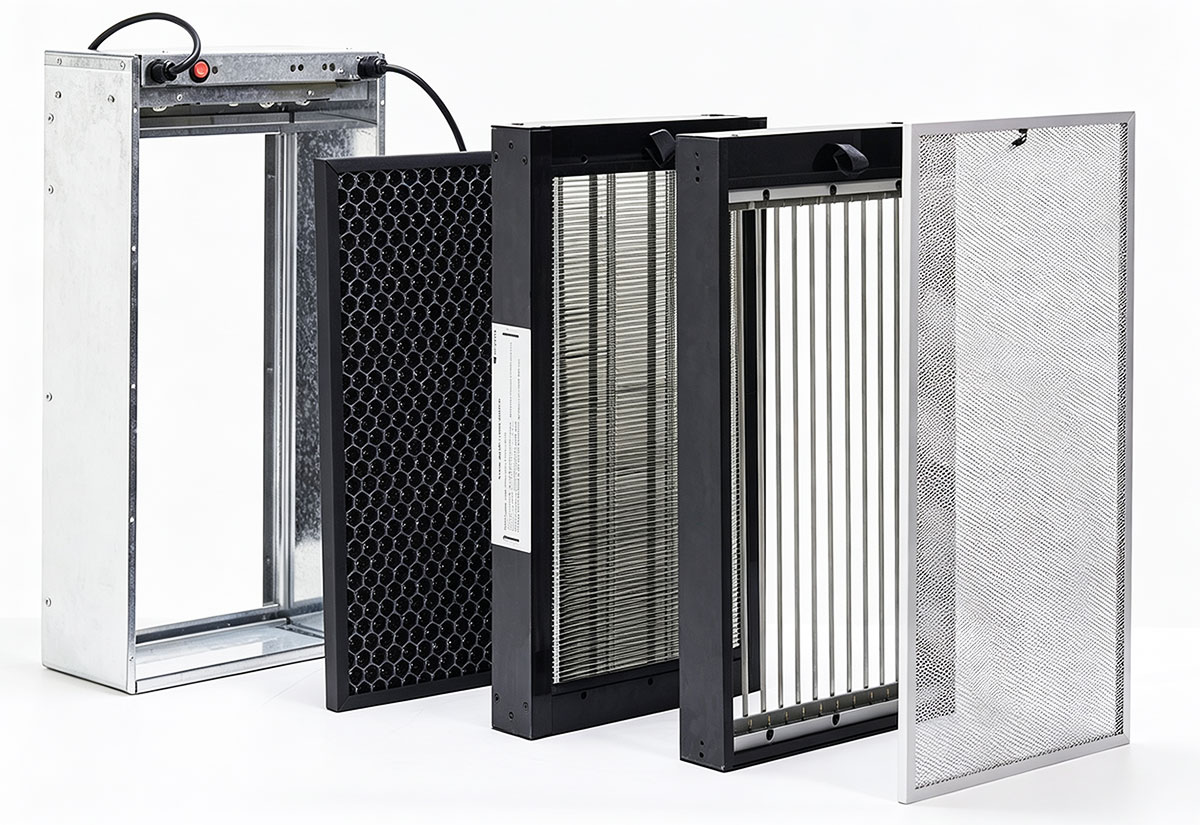
Airdog IEF is an industrial air filtration module based on Airdog's TPA® technology. Designed for integration into HVAC, air handling, and ventilation systems, IEF uses a multi-stage filtration process to remove particles from moving air.
At the core of the system is an active electrical filtration process: particles are first prepared and electrically charged, then collected by electrically charged collection surfaces. Additional filtration components can also help address odors and certain gaseous pollutants.
In simple terms, the IEF process can be understood as:
Pre-Filtration → Particle Charging → Electrostatic Collection → Catalytic Filtration
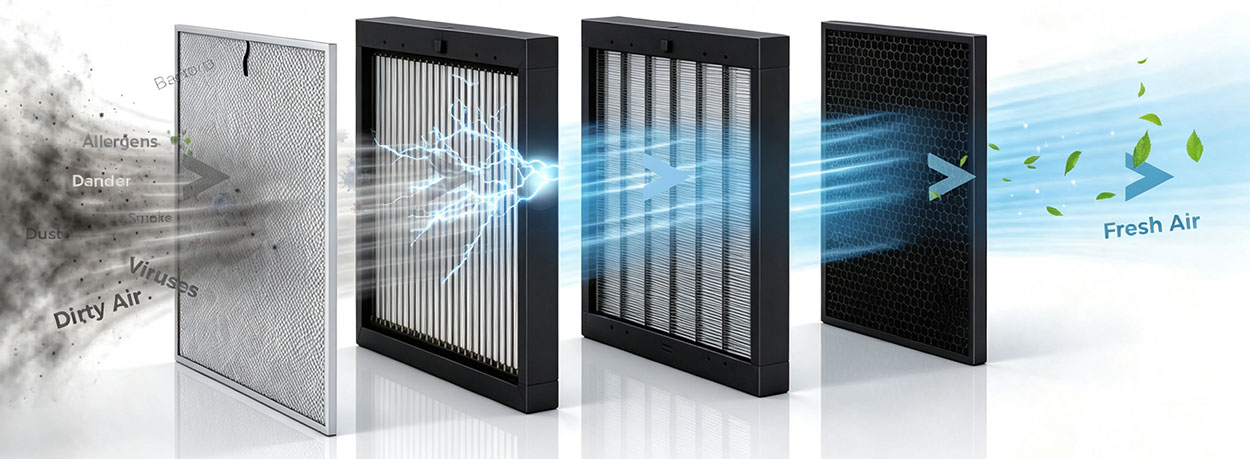
The Four-Stage Working Principle of Airdog IEF
The IEF module uses four primary filtration stages. The first stage handles larger particles, the middle stages use Airdog's TPA® electrical filtration principle to charge and collect fine particles, and the final stage provides additional treatment for odors and certain gaseous pollutants.
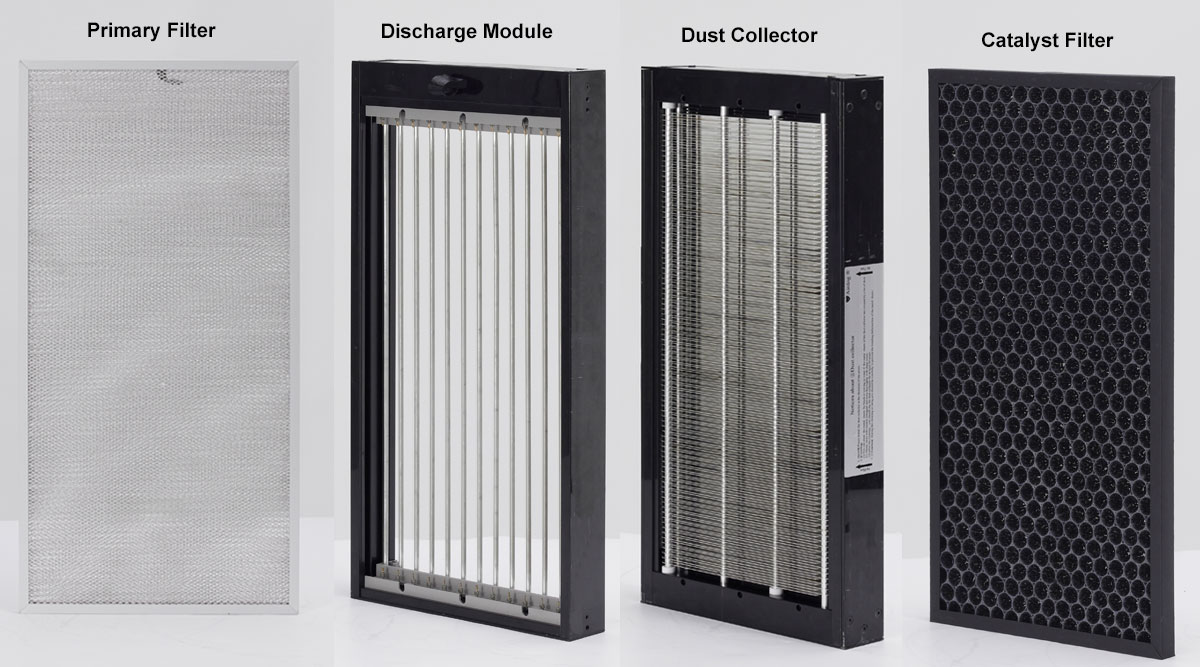
Stage 1: Pre-Filtration
Removing Larger Particles First
When air enters an IEF module, it first passes through a primary filter.
This initial stage is designed to intercept larger airborne particles such as:
Dust
Hair
Larger particulate matter
Other coarse contaminants
The purpose of the pre-filter is not to complete the entire purification process. Instead, it provides an initial level of particle separation before the air reaches the active electronic filtration section.
This staged approach allows the following electrical collection stages to focus on smaller airborne particles.
Stage 2: Particle Charging
Creating an Ionized Electric Field
After passing through the primary filter, the air enters the IEF ionization section.
This is where the principle behind Airdog's TPA® technology becomes particularly important.
The IEF system uses an electrical field between its generating electrodes and collection electrodes. The TPA system creates a high-voltage ion field and uses it to actively charge airborne particles. Bacteria, viruses, and germs present in the air will be killed by the high voltage when passing through this electric field zone. In the test data from the laboratory, the virus removal rate for some samples reached as high as 99.99%.
The basic process can be simplified as:
Airborne particles → Ionization field → Electrically charged particles
Once particles become electrically charged, they can interact with the collection section much more effectively.
This is fundamentally different from relying only on a passive filter surface to intercept particles as air passes through it.
What Happens Inside the Ionization Section?
The IEF Discharge module creates a high-energy electrical field within the filtration module. The working principle:
Air enters the ionization area.
The electrical field interacts with airborne particles.
Particles acquire an electrical charge.
The charged particles continue toward the collection section.
The collection plates attract the charged particles.
The Discharge module and Dust collector(collecting plates) both carry electric charges. A high-voltage electric field will be formed between these two modules. Voltages of tens of thousands of volts can eliminate bacteria, viruses, and other pathogens.
The important point is that particle charging prepares the particles for the next stage of the process.
Stage 3: Electrostatic Collection
Capturing Electrically Charged Particles
Once particles have been electrically charged, they enter the IEF collection section.
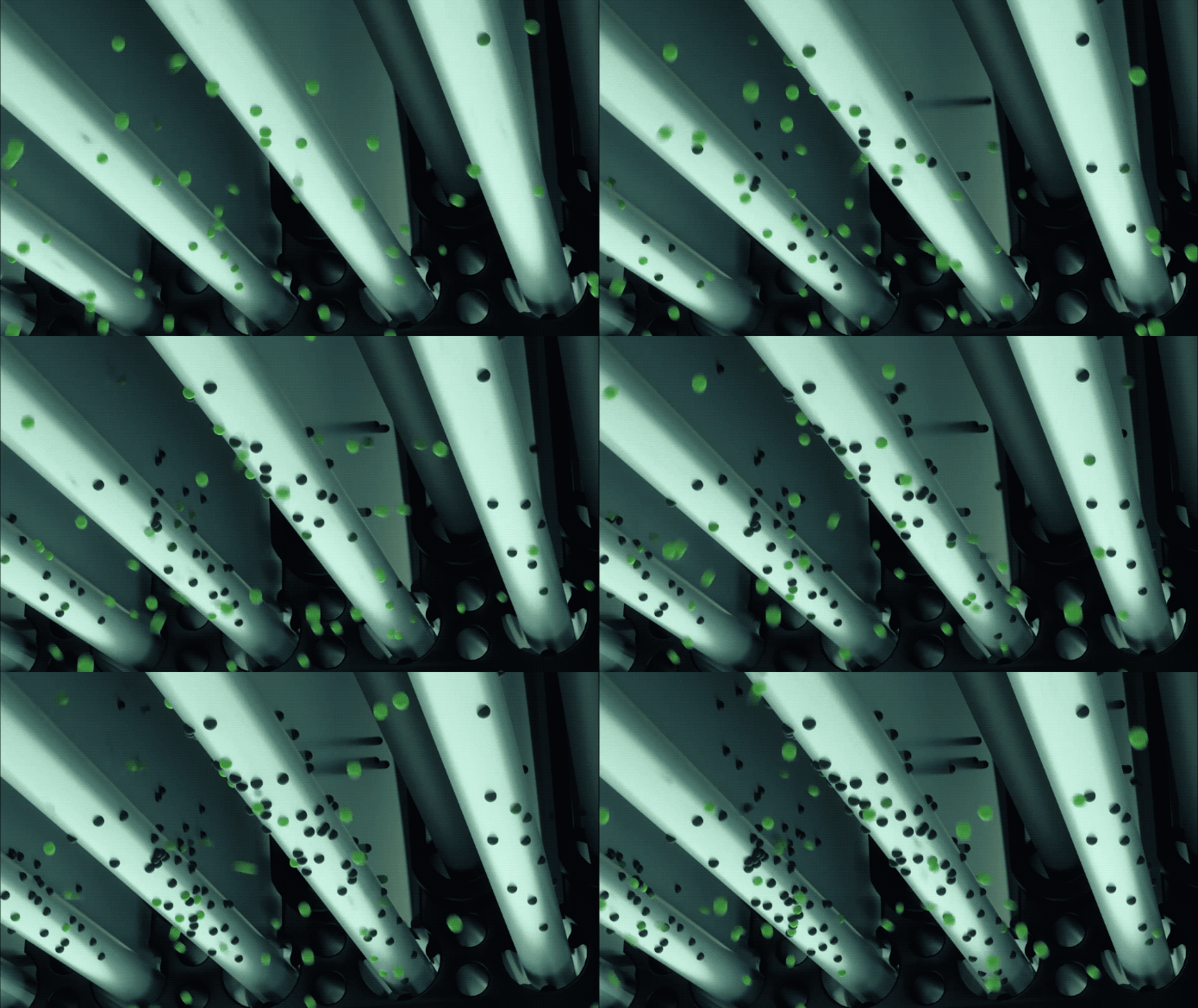
The collection section contains specially designed collector plates. The charged particles are attracted to these surfaces and are captured rather than simply passing through with the airflow.
This is the core electrostatic collection process.
In simplified form:
Charged particle + collection field → particle captured on collector plate
Why Does Electrical Charging Matter?
A conventional mechanical filter mainly relies on the physical interaction between particles and filter media.
IEF takes a different approach.
Instead of simply waiting for particles to collide with a filter surface, the system first gives particles an electrical charge and then uses an electrical field to attract them to the collector.
This creates an active particle collection process.
The conceptual difference can be represented as:
Conventional mechanical filtration
Air → Filter media → Particle interception
Airdog IEF
Air → Particle charging → Electrical attraction → Particle collection
Stage 4: Catalytic Filtration
Additional Treatment for Odors and Gaseous Pollutants
After the particle collection stage, the air passes through the final filtration component. This is intended to address odors and certain gaseous pollutants.
This means the four-stage IEF system is not based exclusively on particle collection.
Its different stages have different functions:
Stage | Main Function |
Primary Filter | Captures larger particles |
Ionization | Electrically charges airborne particles |
Collection Plate | Captures charged particles |
Catalytic Filter | Helps address odors and certain gaseous pollutants |
The Complete IEF Air Filtration Process
When the four stages are combined, the working process can be visualized as follows:
Step 1 — Air Intake
Contaminated air enters the IEF module through the ventilation or HVAC system.
Step 2 — Pre-Filtration
Larger particles such as dust and hair are intercepted.
Step 3 — Particle Charging
Smaller airborne particles pass through the ionization field and become electrically charged. A high-voltage electric field will be formed between step3 and step4, where bacteria and germs in the air are killed.
Step 4 — Electrostatic Collection
Charged particles are attracted to the collector plates and captured.
Step 5 — Catalytic Filtration
The air passes through the catalytic carbon component for additional odor and gaseous-pollutant treatment, depending on the product configuration.
Step 6 — Treated Air
The treated air continues through the ventilation system.
Related Articles
-
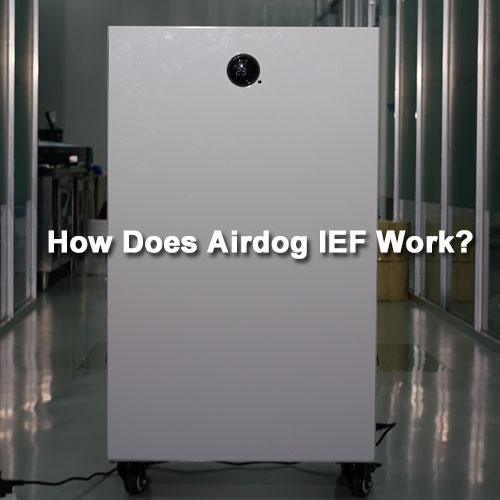 IEF uses Airdog's TPA® (Two Pole Active) technology, derived from ionized wind technology and developed for active electronic air filtration. Airdog IEF uses a four-stage process: pre-filtration, particle charging, electrostatic collection and catalytic filtration. The result is a modular industrial air filtration approach that can be incorporated into suitable HVAC, air handling and ventilation systems.News
 -
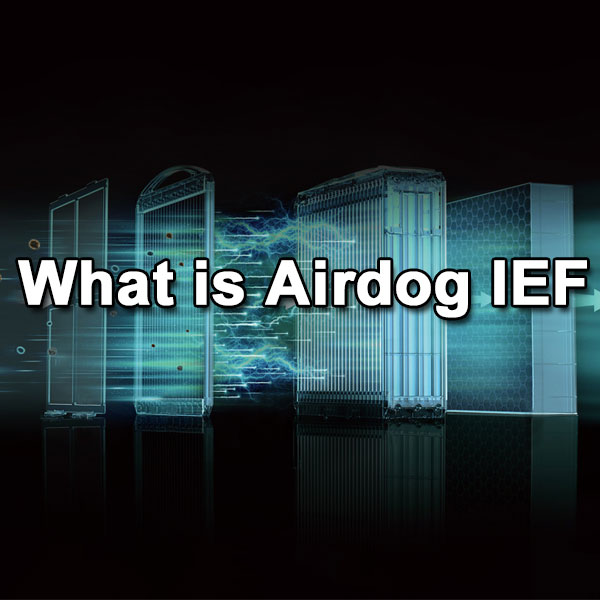 Airdog IEF is an industrial electronic air filtration solution based on Airdog's TPA® technology, designed to integrate with HVAC, air handling and ventilation systems. Its active electrical particle collection mechanism, washable collection components and modular architecture provide an alternative approach to conventional disposable mechanical filtration for suitable commercial, institutional and industrial applications.News
 -
 BackgroundIndoor air quality has become a critical concern in schools, where hundreds of students and teachers share enclosed classrooms daily. In this particular teaching building, the existing central air conditioning system provided adequate ventilation but failed to effectively remove fine partiHospital
