


Mushroom cultivation requires a carefully managed growing environment. Temperature, humidity, ventilation and air quality all play important roles in maintaining suitable cultivation conditions.
Airborne contaminants are another consideration.
Fungal spores, microorganisms and other airborne contaminants can circulate through indoor cultivation environments. For growers operating multiple growing rooms or controlled cultivation facilities, managing the air environment can therefore become an important part of the overall cultivation strategy.
This has created interest in specialized air-treatment technologies designed to continuously process the air within mushroom-growing environments.
SporeTect integrates the Airdog IEF technology module. development of portable air-treatment equipment designed specifically for environments where airborne fungal spores and microbial contaminants need to be addressed.

Why Air Quality Matters in Mushroom Cultivation
Mushrooms are cultivated in controlled environments where environmental conditions need to remain within an appropriate range.
Air movement is essential for ventilation and environmental management, but the same air circulation can also distribute airborne particles and microorganisms throughout a growing area.
Potential airborne contaminants can include:
Fungal spores
Microbial contaminants
Fine particulate matter
VOCs and other airborne compounds
The objective of air treatment is therefore not simply to "clean the air." It is to help create a more controlled air environment around the cultivation process.
An air-treatment system can continuously draw room air through a treatment unit, process the airborne contaminants, and return treated air to the cultivation environment.
What Are Fungal Spores?
Fungal spores are microscopic reproductive particles produced by fungi. Because of their small size, spores can become airborne and move through indoor environments.
In mushroom-growing environments, airborne fungal spores are therefore one of the potential contaminants that may need to be considered as part of environmental management.
Specialized air-treatment technologies can be designed to address airborne spores by combining particle removal with other treatment mechanisms.
SporeTect is a Zero-Waste, portable, and energy-efficient solution. eliminate airborne fungal spores, microbial contaminants and VOCs safely, effectively, and without chemicals.
The SporeTect is designed to address airborne fungal spores, microbial contaminants and VOCs. It combines cold plasma technology with electrostatic precipitation (ESP) and is designed to perform the inactivation or treatment of contaminants within the device.
How Specialized Air Treatment Works
Different air-treatment systems can use different technologies.
Cold Plasma
Cold plasma, also referred to as non-thermal plasma, is generated by an electrical field. The technology produces reactive species such as ions, electrons and radicals.
According to the supplied material, these reactive species interact with fungal spores, microbial contaminants and VOCs without relying on heat or conventional chemical treatment.
Electrostatic Precipitation
Electrostatic precipitation efficiently removes ultra-fine airborne particulate matter, reducing air contamination while operating with low energy consumption and without the need for replacement disposable filters.

Airdog IEF and Specialized Air Treatment
Airdog IEF is a modular industrial air-treatment technology based on Airdog's TPA® technology.
The IEF platform is designed primarily for active air filtration and can be integrated into HVAC systems, ventilation equipment and customized air-treatment machines.
This modular approach makes it possible to develop different equipment configurations for different environments.
For specialized agricultural applications, an IEF-based system can therefore be considered as a technology platform for customized air-treatment equipment, with the final system configuration depending on the required airflow, target contaminants and operating environment.
Independent testing of Airdog IEF was conducted in Suzhou. The test evaluated the microbial purification efficiency of the IEF electrostatic air filter for ventilation systems in accordance with GB/T 34012-2017.
Under a tested air volume of 2,434 m³/h, Airdog IEF achieved a 99.36% microbial purification efficiency, meeting the report's Level A requirement of greater than 90%.
This result provides laboratory-based evidence of IEF's ability to purify microorganisms from treated airflow under the specified test conditions. Actual performance in HVAC systems or application environments may vary depending on airflow, system configuration, installation conditions and other operating parameters.

From Air Filtration to Agricultural Applications
The mushroom application illustrates a broader principle:
Industrial air-treatment technology can be adapted to environments where air quality is part of the production process.
This concept can extend beyond mushroom cultivation to other controlled agricultural environments where airborne particulate or microbial contamination needs to be managed.
The exact technology combination should always be selected according to the target contaminant, environmental conditions and required performance.
The IEF platform is designed primarily for active air filtration and can be integrated into HVAC systems, ventilation equipment and customized air-treatment machines.
This modular approach makes it possible to develop different equipment configurations for different environments.
Related Articles
-
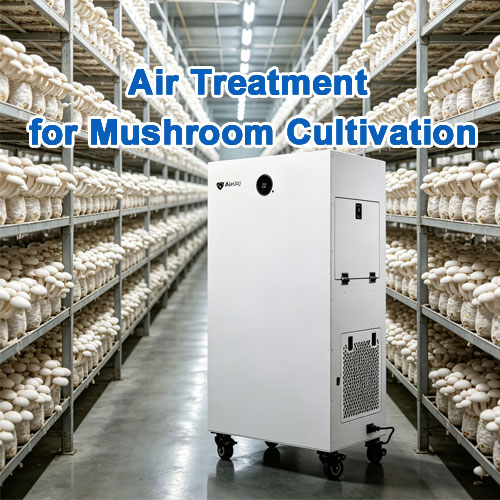 For IEF-based applications, the technology can be incorporated into customized equipment according to the specific requirements of the cultivation environment. Specialized systems can combine electrostatic precipitation to address different types of airborne contaminants. The supplied mushroom application demonstrates how a portable air-treatment system can be used in controlled indoor cultivation environments. Mushroom cultivation environments can benefit from careful management of the surrounding air.News
-
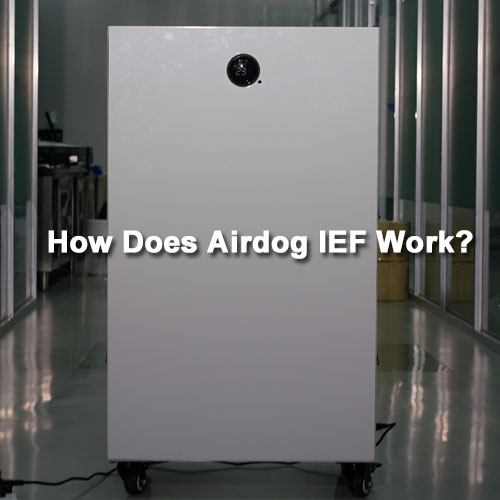 IEF uses Airdog's TPA® (Two Pole Active) technology, derived from ionized wind technology and developed for active electronic air filtration. Airdog IEF uses a four-stage process: pre-filtration, particle charging, electrostatic collection and catalytic filtration. The result is a modular industrial air filtration approach that can be incorporated into suitable HVAC, air handling and ventilation systems.News
-
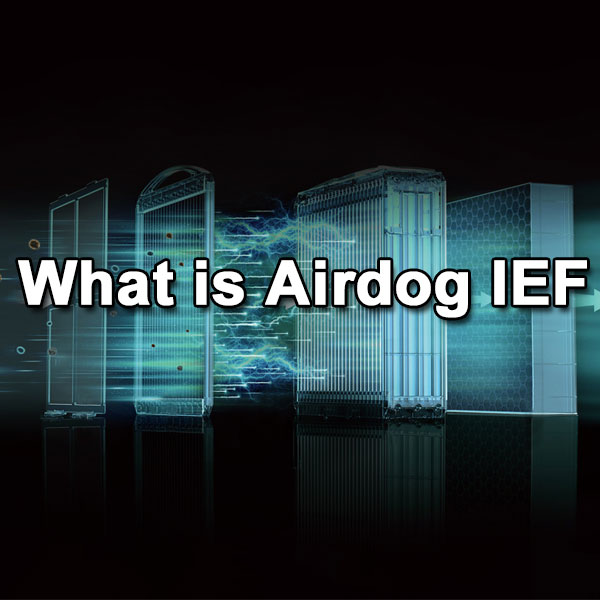 Airdog IEF is an industrial electronic air filtration solution based on Airdog's TPA® technology, designed to integrate with HVAC, air handling and ventilation systems. Its active electrical particle collection mechanism, washable collection components and modular architecture provide an alternative approach to conventional disposable mechanical filtration for suitable commercial, institutional and industrial applications.News
